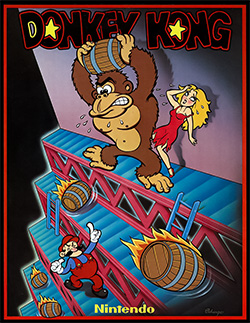
Donkey Kong 鈥?The Game That Introduced Mario to the World
Category: Arcade / Platformer | Developer: Nintendo | Designer: Shigeru Miyamoto | Year: 1981 | Play: Browser (DOSBox) | Price: Free
About This Classic
In 1981, Nintendo was in trouble. Their Radar Scope arcade game had bombed in North America, leaving 2,000 unsold cabinets sitting in a warehouse. Company president Hiroshi Yamauchi handed a young staff artist named Shigeru Miyamoto an impossible task: design a game that could be installed in those existing cabinets and would actually sell. Miyamoto, who had never designed a game before, created Donkey Kong 鈥?and not only saved Nintendo from financial disaster but introduced the world to a character who would become the face of video games: Mario.
Originally conceived as a Popeye game (Nintendo couldn’t secure the license), Donkey Kong repurposed the love triangle into an original story: a giant ape kidnaps a lady (Pauline) and climbs a construction site. You control Jumpman (later renamed Mario), a carpenter who must climb the structure, dodge barrels, and rescue the damsel. The game spans four distinct stages, each introducing new challenges and mechanics 鈥?a narrative structure that was unprecedented in 1981.
Gameplay and Tips
Stage 1: 25m (Barrel Stage)
Donkey Kong rolls barrels down sloped girders. Barrels follow a predictable path but can bounce unpredictably down ladders.
- Jump Timing: Jumping over barrels is your primary defense. The jump has a slight delay 鈥?press early. Practice the timing until it’s second nature.
- Hammer Power-Up: A golden hammer appears near the bottom. Grab it to smash barrels for points 鈥?but you can’t climb while holding it. The hammer lasts a fixed time then disappears.
- Climb Smart: Don’t rush straight up the center ladders. Use the outside ladders to avoid barrel clusters.
Stage 2: 50m (Conveyor Belt Stage)
Cement pans (fireballs) chase you across conveyor belts.
- Conveyor Movement: Moving with the belt speeds you up; against it slows you down. Use this to outmaneuver fireballs.
- Hammer on Belts: The hammer appears on the upper conveyor. It’s harder to use here because the belt carries you 鈥?plan your approach.
Stage 3: 75m (Elevator Stage)
Riding elevators and dodging bouncing springs. The most technical stage.
- Spring Timing: Bouncing springs move in arcs. Wait in the gaps between them before moving.
- Elevator Patience: Elevators move on fixed cycles. Wait for them 鈥?don’t jump to a platform that isn’t there yet.
Stage 4: 100m (Rivet Stage)
Remove the eight rivets holding the platforms together. When all rivets are removed, Donkey Kong falls and Pauline is saved.
- Rivet Route: Plan the most efficient path. You need to cross each rivet exactly once.
- Watch DK: Donkey Kong stomps and throws debris. Keep moving.
Controls
- Left / Right Arrow 鈥?Move
- Up Arrow 鈥?Climb ladders
- Down Arrow 鈥?Descend ladders
- Space 鈥?Jump
- Alt+Enter 鈥?Toggle fullscreen
Why It’s a Legend
Donkey Kong was revolutionary in ways that are hard to appreciate today. In 1981, arcade games didn’t tell stories 鈥?they were abstract tests of reflexes. Donkey Kong had a plot, characters with personality, cutscenes (DK grabbing Pauline, Mario’s death animation), and progressive stage design with escalating difficulty. It was arguably the first narrative video game.
The game introduced Mario 鈥?who would become the best-selling video game character in history, anchoring franchises worth over billion. It also introduced Donkey Kong, whose own series has sold over 65 million copies. No other single game has launched two characters of this magnitude.
The game also sparked one of the most famous lawsuits in entertainment history: Universal Studios sued Nintendo, claiming Donkey Kong infringed on King Kong. Nintendo’s attorney John Kirby (for whom the character Kirby is named) proved that Universal had actually argued in a previous case that King Kong was in the public domain. Nintendo won and Universal had to pay Nintendo .8 million in damages 鈥?a David-vs-Goliath legal victory that gave Nintendo the confidence to challenge the American entertainment establishment.
Did You Know?
- Mario was originally named “Mr. Video,” then “Ossan” (Japanese for “middle-aged man”), then “Jumpman” before settling on Mario 鈥?named after Mario Segale, Nintendo of America’s landlord who reportedly burst into a meeting demanding overdue rent.
- The game’s iconic “hammer” theme music is one of the most sampled pieces of video game music in hip-hop history.
- The world record for Donkey Kong high score was the subject of the 2007 documentary “The King of Kong: A Fistful of Quarters,” widely considered one of the best video game documentaries ever made.
- The current world record (1,272,800 points) was set by Robbie Lakeman in 2021, breaking records that had stood for years.
- Shigeru Miyamoto had no programming experience when he designed Donkey Kong. He communicated his ideas to programmer Gunpei Yokoi using hand-drawn sketches and written descriptions.
- Donkey Kong is preserved in the Smithsonian Institution’s permanent collection as one of the most culturally significant artifacts of the 20th century.
Powered by Internet Archive 路 DOSBox emulator. No download required!
💬 Comments & Reviews
Enjoying Browser Games? Try Steam!
Discover thousands of games on the world’s largest PC gaming platform. Free-to-play, indie gems, AAA blockbusters — something for everyone.
Support Indie Developers on itch.io
Discover unique indie games made by creators worldwide. Many are free or pay-what-you-want!